
Automating Your Creative Career: The Rise of AI Content Syndication in 2026
Introduction: The Content Arbitrage Era
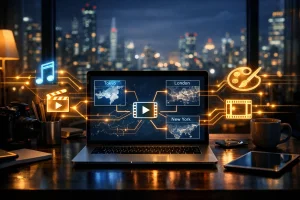
The creative landscape of 2026 has undergone a fundamental shift. We have moved past the era of manual content creation and entered the age of Content Syndication and Licensing Arbitrage. In this new reality, a single high-quality creative asset—be it a video, a piece of music, or an educational guide—can be automatically localized, reformatted, and licensed across dozens of global marketplaces. For the modern creator, success is no longer about how many hours you spend behind a desk; it's about how many autonomous systems you have working to distribute your intellectual property.What is Global Content Syndication?
Syndication is the process of taking a piece of content and distributing it to multiple platforms, networks, or marketplaces simultaneously. In 2026, AI has turned this from a manual chore into a "set-and-forget" revenue stream. Through Syndication Arbitrage, you can produce content in one language and use AI tools to flawlessly translate, culturalize, and publish it in regions with higher advertising rates (CPM) or stronger licensing demand, such as the US, Japan, or Northern Europe.Key AI Tools Driving the Creative Automation Revolution
To compete in the 2026 market, you need a stack that handles more than just generation; you need a stack that handles Distribution and Licensing Logic.1. Localization and Culturalization Agents
Traditional translation is dead. In 2026, tools like (imaginary) LingoScale AI don't just translate words; they adapt the cultural context, slang, and even the visual elements of a video to fit local sensibilities. This allows a creator in Istanbul to produce a children's yoga video and have it resonate perfectly with an audience in Tokyo or New York, maximizing global reach.2. Automated Licensing Engines
Licensing your work (photos, music, code) used to involve complex legal hurdles. Today, AI-powered licensing engines like (imaginary) RightsMaster 2026 scan global marketplaces to find where your specific style or niche is in high demand. They automatically list your assets, handle the micro-licensing contracts through smart contracts, and collect payments in real-time.3. Generative Asset Multipliers
Instead of creating one image, you use AI to create a "Style Model." In 2026, you can license your own AI model to agencies. This allows them to generate images in your unique aesthetic while you receive a royalty for every generation. This is the ultimate form of passive creative income.Step-by-Step: Building Your Automated Creative Empire
Step 1: Niche Selection and High-CPC Targeting
In the arbitrage world, not all content is equal. High-CPC niches for 2026 include:- []Renewable Energy Tech Visuals: Huge demand for eco-tech stock imagery.[]AI Workforce Education: Specialized guides on how to use specific AI tools.
- Global Wellness and Yoga: High engagement and premium ad rates in the wellness sector.
Step 2: The Production Loop
Use AI to produce your core assets. For instance, if you are targeting the children's yoga niche (like our LenaKidsYoga reference), use AI to generate high-fidelity background music and localized voiceovers. The goal is to create a "Master Asset" that can be split into 100 micro-assets.Step 3: Deployment to Marketplaces
Don't just post on YouTube. Use your distribution agents to push content to:- []Stock Platforms: Adobe Stock, Getty (for visual and video assets).[]Educational Marketplaces: Udemy, Teachable (for depth-heavy guides).
- Social Syndicators: Automatic posting to Pinterest, X, and Meta to drive traffic back to your forum, Axiir.com.
The Math of Creative Arbitrage
Let's look at the numbers. If producing a high-quality, AI-assisted video series costs you $200 in compute time and AI subscriptions, but through syndication it generates:- []$300 from AdSense on a US-targeted site.[]$150 from stock footage licensing.
- $200 from localized versions in Europe.
Risk Management and IP Protection
In 2026, the biggest risk is "AI Scrapers" stealing your style. Protect your work by:- []Using Invisible Watermarks: Tools like SynthID ensure your AI-generated assets are traceable back to you.[]Direct-to-Community Platforms: Driving traffic to your own forum (Axiir) ensures you own the audience data, not just the social media algorithm.
Conclusion: The Future Belongs to the Orchestrators
The "Starving Artist" trope is a thing of the past. In 2026, the artists who thrive are those who embrace the role of the Orchestrator. By combining your unique creative vision with the raw power of AI distribution agents, you can scale your influence and your income far beyond what was possible in the manual era. Start automating your career today, one asset at a time.Note: All tools mentioned are for illustrative purposes based on 2026 tech trends. For real-time tool reviews, visit our Guides Section.